
Seminole Parole Versus Probation
Oklahoma divides parole consideration from community supervision. The Oklahoma Pardon and Parole Board reviews eligible state prisoners and publishes hearing material. ODOC Probation and Parole Services supervises people in the community under eligible parole and probation sentences. The Seminole County court record supplies the judgment that may impose a suspended or deferred sentence, while ODOC supplies the state corrections and supervision trail.
| Feature | Parole | Probation |
|---|---|---|
| How it begins | Conditional release after imprisonment, following the required parole process. | A court sentence or arrangement, often suspended or deferred, which may occur without state prison release. |
| Main record | PPB docket/result, later ODOC status, and supervision record. | Court judgment or deferred/suspended terms, plus ODOC supervision status where applicable. |
| Who supervises | ODOC Probation and Parole Services. | ODOC Probation and Parole Services when the sentence is assigned to that system. |
| How it ends | Discharge after the legal parole obligation ends. | Completion, discharge, dismissal after a qualifying deferred path, or another court action. |
Probation is not proof of a prior prison release. Parole normally follows imprisonment, but a Board action is not a physical release receipt. To answer whether the person actually left a jail or state facility, check the custodial agency and status event separately.
- Parole
- Conditional community release for the remaining part of a prison term.
- Probation
- Court-ordered supervision in the community, sometimes linked to a suspended or deferred sentence.
- Discharge
- The legal end of a custody or supervision obligation shown by the controlling agency record.
- Absconder
- A person alleged to have stopped reporting or remaining available to supervision.
Verify Seminole Post-Release Supervision
Start with the person's DOC number if known. Names alone can produce false matches, especially when middle names or aliases differ. Use the court case to confirm that the ODOC record belongs to the same person. Then read the exact status rather than inferring supervision from a prior conviction or old hearing entry.
- Search the ODOC Offender Lookup by DOC number or name. Compare birth date, aliases, conviction county, offense, and case details.
- Search the OSCN court docket with Seminole County selected. Read the judgment, suspended or deferred terms, revocation entries, and later orders.
- Call the local Probation and Parole routing number at 405-257-5417. Ask whether it is the correct office and how the person can reach an assigned officer.
- If parole is involved, search the Board's official docket and result records. Match the name, DOC number, institution, and meeting date.
- Confirm physical release through ODOC or VINE. Do not treat a hearing result or eligibility date as proof of discharge from custody.
The Seminole County released inmate search path explains how county release, ODOC transfer, and federal custody differ. That boundary matters here because someone can leave the county jail for ODOC and remain incarcerated, or leave ODOC on parole and remain subject to supervision.
Note: Ask an office only for information it may lawfully confirm, and use the assigned-officer channel for private case details.
Seminole Supervision Office Details
Seminole County's official directory publishes a local Probation and Parole telephone number separate from the statewide Board. This is the county's distinctive routing point. Call 405-257-5417 for help identifying the correct community-supervision office or reaching the reporting path. No public office address, hours, fee, or name-search database was documented for that local listing, so call before traveling and do not present the number as a public status lookup.
Seminole County Probation & ParoleLocal routing telephone: 405-257-5417
Use: office identification, reporting contact, and record-error routing
Hours and public counter address: not posted in the researched county source
The Seminole County contact directory also lists the jail and Court Clerk, while the Sheriff's official contact page provides the county jail route. Those offices have different roles. The jail confirms county custody or departure. The court file supplies the sentence and later orders. The supervision contact deals with an active community-supervision route, not a jail release timestamp.
For state-level records, ODOC Legal Services lists closed-record and discharge channels. Public staff may not disclose risk assessments, treatment information, residence data, internal notes, or other restricted material. A public offender record is the first check, not a promise that the full supervision file is open.
Seminole Parole Hearing Records
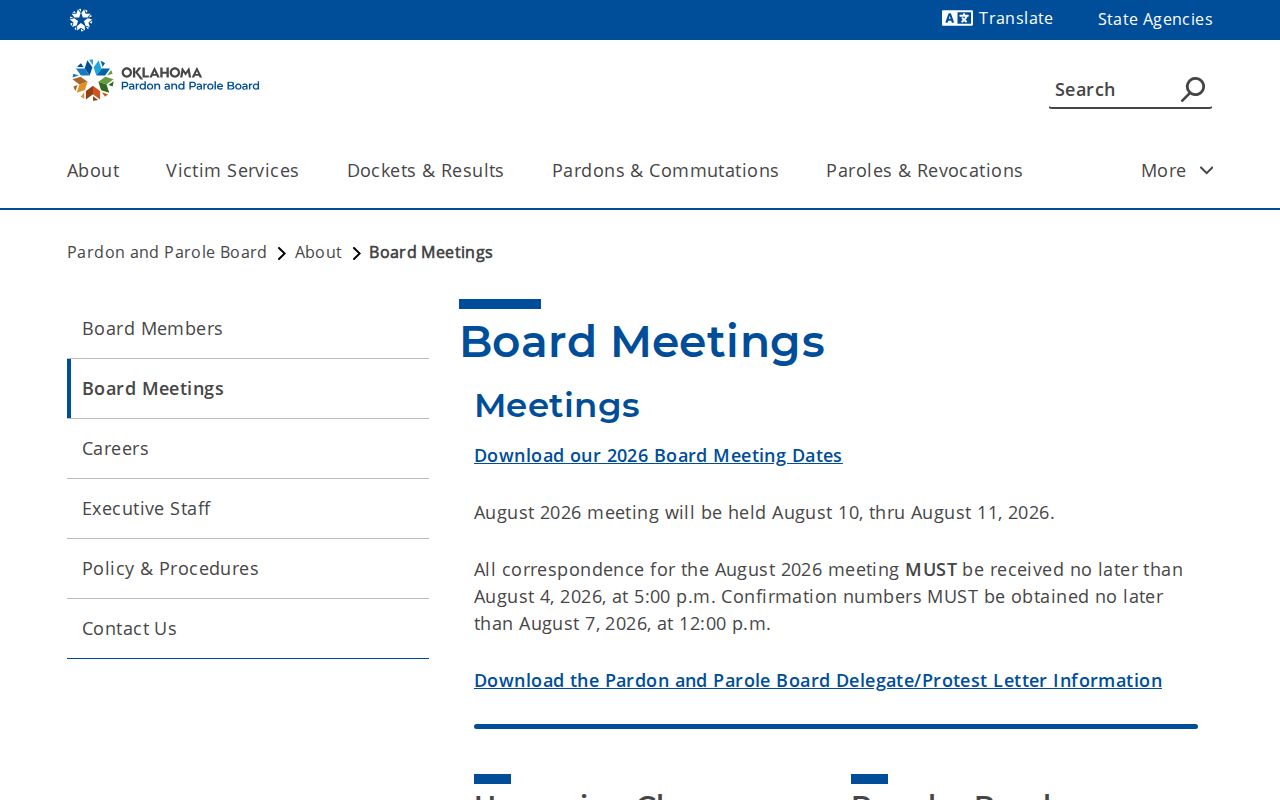
The Oklahoma Pardon and Parole Board holds regular parole meetings monthly. Use its official meeting calendar for current dates and locations, then use the dockets and results gateway. A docket asks whether the person was scheduled for consideration. A result shows Board action. Neither one alone answers whether ODOC later completed release.
The official Board calendar capture gives the live schedule context used for Seminole County parole inquiries.
OAC 515:1-5-1 requires regular monthly dockets at least 20 days before a meeting and supplemental dockets at least 10 days before consideration. Under OAC 515:1-5-2, internet results are due no later than 20 days after the meeting and must remain online for at least 60 days. Search and save the relevant result promptly, since that minimum does not create a permanent online archive.
Read Seminole Parole Outcomes
Search a Board docket by the person's name and DOC number. Confirm the institution and identifying details, then locate the matching meeting result. Use the legend printed with that result. Outcome terms can include approval or recommendation, denial, deferral, pass, continuance, or rescission, but the current document's wording controls.
A favorable result is one point in the process. Gubernatorial action may be required under the governing procedure, and ODOC must still calculate the sentence and complete physical processing. Another sentence, detainer, misconduct issue, or receiving authority can prevent community departure. Confirm a release event through ODOC and Oklahoma VINE.
The Board is at 4345 N. Lincoln Blvd., Suite 1082, Oklahoma City, OK 73105, with telephone 405-521-6600. Its live site should control meeting details because dates and locations can change.
Seminole Parole Eligibility Limits
Oklahoma parole eligibility is governed chiefly by 57 O.S. §332.7 and offense-specific law. Eligibility means the person has reached a point at which consideration may occur. It does not guarantee a favorable result, an immediate meeting, or release.
For offenses enumerated in 21 O.S. §13.1, at least 85 percent of the imposed imprisonment must be served before parole consideration. The rule does not apply to every Oklahoma offense and does not guarantee parole at that point. Offense date, sentence date, consecutive terms, credits, holds, and statutory changes can matter. A simple percentage is not a valid individual release calculation.
A future parole date also differs from discharge. Parole can place a person in the community for the balance of a term. Discharge ends the legal supervision obligation. Use a completed ODOC status or discharge record to verify that endpoint rather than an old docket or forecast.
Seminole Violations and Absconders
Community supervision can include reporting and other lawful conditions in the person's order and supervision plan. Public sources do not expose every term. A claimed violation can lead to a warrant, arrest, revocation process, or other response, but the allegation itself does not prove the person is back in custody.
An absconder is alleged to have failed to remain available or comply with supervision. Verify any warrant through the issuing court or law-enforcement agency. Then check the actual custodian. The Seminole County in-custody roster answers only whether the person appears in the county jail at the search time. Another jail, ODOC, tribal authority, or federal agency requires its own source.
A revocation filing on the court docket also needs context. Read the later entries for warrant recall, hearing, order, sentence change, or commitment. If the person is not found, call the local supervision route rather than assuming supervision ended.
Note: “Absconder,” “warrant issued,” and “in custody” describe different facts and should never be used as interchangeable labels.
Confirm Seminole Supervision Discharge
Supervision ends when the controlling sentence and agency record show completion or discharge, not merely because the person stops appearing in a current jail search. For probation, inspect the Seminole County court docket for completion, dismissal after a qualifying deferred path, revocation, or another final order. For parole, compare ODOC status with any discharge record.
ODOC publishes a discharge-specific contact at osordischarges@doc.ok.gov and a closed-records line at 405-425-2691. Include the person's full name, date of birth, DOC number, and the precise status or discharge document sought. Some supervision material may require the person's authorization, and a public-record request does not override legal confidentiality.
Keep the final statement narrow: the record shows active parole, active probation, discharge, incarceration, or an unresolved status as of a stated time. That wording respects the limits of each source and prevents a Board event from being mistaken for a Seminole County jail release.