
Seminole County Projected Release Meaning
A projected date is a forecast based on the sentence information and credits now recorded. An actual release is the completed event when a named custodian stops holding the person. The two are not interchangeable. A court order may authorize release before jail staff finish processing it, while a projected state date can move before it arrives.
Pretrial detention follows a different rule. Someone held on a pending Seminole County case may leave after bond, recognizance, dismissal, or another court order, but there may be no sentence end date to calculate. Another warrant or detainer can also keep the person held after one case permits release. “Detainer” means another authority has asked the current custodian to hold or transfer the person.
A person transferred from the Seminole County Jail to ODOC has not been released to the community. County custody ended, but state custody began. The sheriff's current inmate search, the district-court judgment, and the ODOC record must be read in sequence.
Find Seminole County Projected Dates
Start by identifying whether the person is pretrial, serving time in the county jail, or serving an ODOC sentence. The source changes with that status. The county has not published a sentence calculator or a local good-time policy, so state-prison credit rules must not be applied automatically to a jail term.
- Search the Seminole County roster to see whether the person is currently held and note the search time.
- Search OSCN by case number or name with Seminole County selected. Read the judgment, bond orders, and jail-time credit entries.
- For a county sentence, call the jail at 405-257-6235 and ask how the signed order and credited time affect the expected transaction.
- For an ODOC commitment, use the official ODOC Offender Lookup and compare the DOC number, identity, offense, conviction county, and status.
- When public fields do not resolve the date, use ODOC sentence administration or the correctional records officer rather than making a private calculation.
The state lookup is a continuing corrections trail, not an archive of every county booking. A person who bonded out and never entered an ODOC sentence may have no state record. A person shown at an ODOC institution remains incarcerated even though the county roster is empty. For a completed local release, the broader Seminole County release record path explains how to request the actual date and type.
Note: A current-custody roster locates someone still held; it does not supply a historical county release date after the card disappears.
Seminole County Date Confidentiality
Oklahoma's terminology creates an important tension. The official ODOC worksheet uses the label “Projected Release Date,” yet ODOC Offender Info says an inmate's exact release date is confidential unless the requester has a legitimate need. It also calls the date tentative because earned-credit level, misconduct, and achievement credits can change the result. That is Section 19's distinctive Angle T, and it rules out a promise that every public offender page will show an exact future date.
The current live record controls. If an ODOC detail screen displays a public date, reproduce the label exactly and keep the tentative warning beside it. If no date appears, do not infer one from sentence length. ODOC says the inmate receives days remaining at the end of each month and may ask a correctional records officer or case manager for help with the calculation. An inmate may choose to share that information.
The ODOC Legal Services contacts include Sentence Administration and Offender Records and Registries. The published discharge email is osordischarges@doc.ok.gov, the closed-records line is 405-425-2691, and the registry or general records line is 405-425-7601. Those routes can clarify the proper request method, but a records request does not override statutory confidentiality.
The official ODOC lookup provides the entry point for public status research.
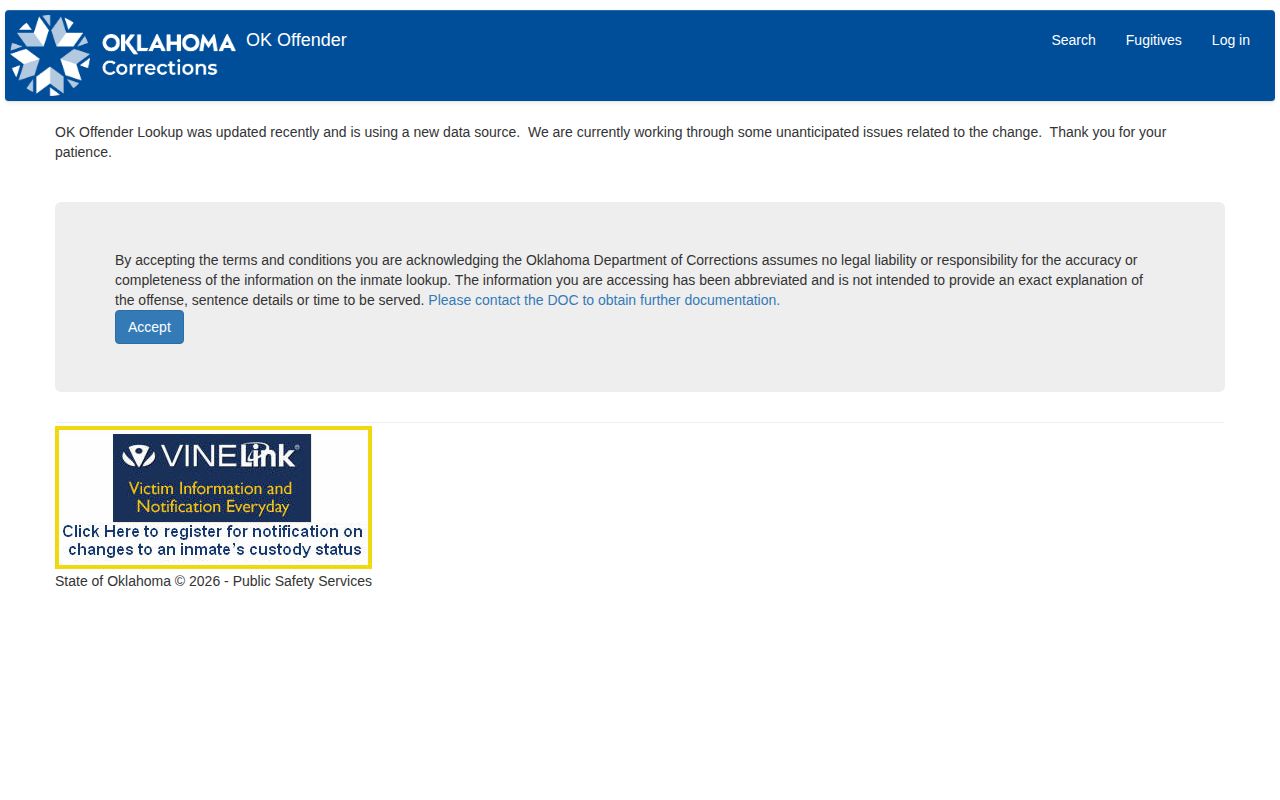
The captured screen supports an identity and status search, while ODOC's separate guidance determines whether a prospective date is available.
Seminole County ODOC Date Calculation
For an ODOC sentence, administration begins with the judgment and sentence, reception date, certified jail-time credit, and whether counts or cases run concurrently or consecutively. Concurrent terms run at the same time. Consecutive terms run one after another. ODOC then applies the credit law and later adjustments to produce the official projection.
57 O.S. §138 establishes class-level earned credits for eligible state inmates and allows specified achievement credits and adjustments. Earned credit reduces the time counted toward sentence completion under the governing rules. Class level can change. Misconduct can lead to loss or affect the rate, while eligible accomplishments can add credits. The statute and current ODOC policy control each case.
These are state-prison rules. Seminole County has not posted a county good-time rule or calculator. A county jail date may instead turn on days stated in the judgment, credit for time already served, a bond event, dismissal, or a release order. Ask the Court Clerk for the public judgment or minute and the jail for the actual transaction.
Note: Do not apply ODOC class credits to a Seminole County jail term unless an authoritative record says the state framework governs.
Seminole County Eighty-Five Percent Rule
21 O.S. §13.1 requires people convicted of its listed serious offenses, including covered attempts, conspiracies, or solicitations, to serve at least 85 percent of the imposed imprisonment before parole consideration. It does not apply to every Oklahoma offense. It also does not guarantee parole when that threshold is met.
Parole consideration and sentence completion answer different questions. The Oklahoma Pardon and Parole Board considers parole under the governing law. ODOC administers the sentence and physical custody. A favorable step in the parole process may still be followed by required action, administrative processing, another sentence, or a hold. Eligibility is not release.
A simple multiplication is unsafe. Offense subsection, offense date, amendments, consecutive terms, credits, and holds can change the legal analysis. Life sentences and special provisions require particular care. Only the current judgment, statutes, and sentence administration can support an individual date.
Why Seminole County Dates Change
A projection uses current inputs. When one input changes, the output may move. Some changes advance the date, while others delay it or make the public estimate less certain. The reason should be verified with the court or agency responsible for that input.
| Factor | Possible effect | Best source |
|---|---|---|
| Earned-credit level | Changes the rate at which eligible ODOC credits accrue. | ODOC records officer or case manager |
| Misconduct | May reduce credits or affect class level. | ODOC sentence administration |
| Achievement credit | May add credit when law and policy permit. | ODOC record |
| Corrected judgment or jail credit | Changes the sentence input or credited starting point. | Court file and ODOC |
| Concurrent or consecutive terms | Changes whether terms overlap or follow each other. | Judgment and sentence administration |
| Detainer or hold | May cause transfer to another authority instead of community release. | Current custodian and receiving agency |
| Parole action | May affect the custody path but is not itself the release transaction. | PPB result and ODOC status |
An unauthorized absence, amended case, or sentence interpretation can also affect the record. The most recent official source should control. Old screenshots and copied dates can become stale without showing why.
Seminole County Weekend Release Dates
No published Seminole County weekend or holiday release policy was found. Do not import a federal or another county's rule. When a local date approaches, call the jail and ask how the signed court order is being processed. Treat the reply as specific to that case unless the sheriff identifies a written countywide policy.
Processing can separate legal authority from physical departure. A court may enter an order, staff may need to check other holds, and another agency may accept custody. The jail transaction is the best source for when county custody actually ended. The Court Clerk at 405-257-6236 can route requests for the judgment, bond order, or minute that supplied legal authority.
The official county contacts page lists the jail and Court Clerk as separate offices. That separation is useful: ask the court what was ordered, then ask the jail what occurred.
Confirm Seminole County Actual Release
For county custody, call the jail and request the release date, time, type, and receiving agency. If durable proof is required, make a narrow Open Records Act request for the booking and release transaction. Give the full name, date of birth or booking number, and a date range. Ask for existing records rather than a new calculation.
For state custody, compare the ODOC public status with the sentence record. A past discharge is stronger evidence of a completed event than a projected date. Parole means conditional community release for the balance of the term, while discharge ordinarily marks the legal end of the department's sentence or supervision obligation.
Pending releases can also be monitored through the Seminole County VINELink check. Register on the correct record, then verify the notice with the custodian. A VINE alert can establish a custody change, but the agency remains the source for exact physical departure and destination.